



No products in the cart.
You can identify high-quality laundry cabinets in 2026 by verifying that they use E0-rated High Moisture Resistant (HMR) carcasses and account for modern appliance depths. A successful laundry fit-out requires a 650mm benchtop depth to accommodate rear plumbing and front-loader protrusion, ensuring a flush finish. For safety and mould prevention, any laundry cabinets enclosing a dryer must meet the AS 1668.2 ventilation standard, providing a minimum of 40 litres per second of airflow. Selecting pre-assembled units further ensures structural integrity and precision in high-moisture environments.
How to choose laundry cabinets that actually fit modern appliances
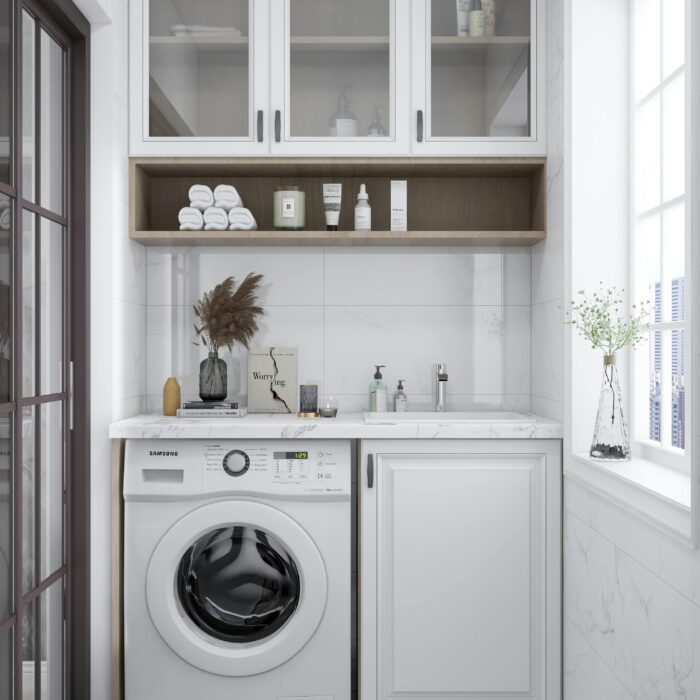
To choose laundry cabinets that fit modern appliances, you must design for a 650mm benchtop depth rather than the standard 600mm kitchen depth. Modern front-load washing machines and dryers are deeper than historical models and require at least 50mm of rear clearance for plumbing hoses and power cables. Providing this extra depth ensures the machine doors sit flush with the cabinetry, preventing obstructions in the walkway and creating a streamlined, professional aesthetic in both open laundries and European-style cupboards.
Why is HMR board essential for laundry cabinets?
High Moisture Resistant (HMR) board is essential for laundry cabinets because it contains specific resins that prevent the wood fibres from swelling when exposed to steam or humidity. In the high-moisture environment of an Australian laundry, standard MDF or chipboard can degrade and delaminate within months. Verifying that your cabinetry uses E0-rated HMR carcasses ensures that the units remain structurally sound while meeting safety standards for low formaldehyde emissions, protecting both your investment and your home air quality.
Benefits of moisture-resistant structural components
- HMR Carcass: Resists swelling and warping in high-humidity laundry zones.
- PVC Kickboards: Provides a 100 percent waterproof barrier against floor spills and wet mopping.
- PUR Edge Banding: Creates a watertight seal on all panel edges to prevent steam penetration.
- Adjustable Legs: Keeps the timber carcass elevated off the floor to prevent direct water contact.
What are the ventilation requirements for European laundry cabinets?
The ventilation requirements for European laundry cabinets are governed by Australian Standard AS 1668.2, which dictates airflow for dryers installed in enclosed spaces. To prevent fire risks and mould growth, a vented dryer requires a minimum extraction rate of 40 litres per second, while a condensing or heat pump dryer requires at least 20 litres per second. This airflow can be achieved through mechanical exhaust fans or by installing slatted door panels that allow for natural air exchange within the cupboard.
Should you choose a laundry tub or a laundry sink?
The choice between a laundry tub and a laundry sink depends on the available space and the intended utility of the room. A freestanding laundry tub offers a larger volume, typically 30 to 45 litres, making it the superior choice for heavy-duty soaking or washing bulky equipment and pets. Conversely, an undermount laundry sink integrated into a benchtop provides a more modern aesthetic and maximises folding space, making it ideal for compact laundries where benchtop real estate is at a premium.
How to design a powered utility cabinet for modern technology
To design a powered utility cabinet, you must integrate internal power points (GPOs) at a height of approximately 1200mm to 1400mm. This configuration allows for the storage and charging of cordless stick vacuums and steam mops within the cabinetry, keeping high-traffic areas clear. The internal shelving should be adjusted to provide a minimum vertical clearance of 1400mm for most modern cleaning appliances, and the cabinet should be constructed with moisture-resistant laundry cabinets to protect electronic components from laundry steam.
Frequently Asked Questions About Laundry Cabinet
How deep should a laundry benchtop be for a front loader?
The 2026 industry standard for a laundry benchtop is 650mm. This accounts for the 50mm of rear plumbing clearance and the door protrusion of high-capacity machines, ensuring they sit flush with the laundry cabinets.
How do I prevent mould in a European style laundry cupboard?
Prevention requires adhering to AS 1668.2 airflow standards. You must provide adequate ventilation through louvred doors or a mechanical exhaust fan to ensure a minimum of 40 L/s extraction for vented dryers.
Are kitchen cabinets suitable for use in a laundry?
Only if they are constructed from High Moisture Resistant (HMR) board. Builders Discount Warehouse uses HMR carcasses across its Manu and Universal ranges, making them suitable for the high-humidity environment of a laundry.
What is the best way to store a stick vacuum in a laundry?
Store it in a tall utility cabinet with an internal power point. This ensures the vacuum is hidden and charged while protecting it from the steam and moisture common in laundry rooms.
Should I choose a laundry tub or an undermount laundry sink?
A laundry tub is better for heavy-duty soaking and maximum volume. An undermount laundry sink is better for a seamless designer look and increasing the available benchtop surface area.
Transform your laundry with Builders Discount Warehouse
Future-proofing your laundry requires a technical approach to moisture protection and appliance compatibility. At Builders Discount Warehouse, we specialise in pre-assembled laundry cabinets that meet the highest Australian standards for durability and safety. By using E0-rated HMR board and moisture-proof PVC kickboards, we provide cabinetry that withstands the rigours of modern family use.
Don't risk a design failure with shallow benchtops or low-grade materials. Visit our showrooms in Brendale, Slacks Creek, or the Gold Coast with your appliance specifications. Our technical specialists will help you select the right laundry tub and moisture-resistant laundry cabinets to create an efficient, long-lasting utility space. Explore our full collection online or visit us in-store today to see the BDW quality difference.